Intro
Je développe une pratique de recherche-création située à l’intersection des arts visuels, de l’anthropologie environnementale et de l’anthropologie du vivant. Formé en arts visuels et engagé dans un parcours doctoral en anthropologie, j’aborde la création comme une manière d’enquêter sur les relations humain-animales, les milieux aquatiques, les infrastructures et les formes de passage qui les traversent.
Mon travail s’intéresse aux rencontres parfois frontales entre les êtres vivants et les aménagements humains : un barrage dans une rivière, une passe migratoire, une ligne de courant interrompue, un corps déplacé par un dispositif technique. À partir de milieux liés au fleuve Saint-Laurent, à ses affluents et à certains territoires riverains, j’observe comment les trajectoires du vivant sont transformées, fragmentées ou contournées.
Les lignes occupent une place centrale dans cette démarche, mais elles ne sont pas seulement des signes à interpréter. Elles existent aussi pour elles-mêmes. Dans mes dessins, elles s’accumulent, se croisent et se densifient jusqu’à former des circulations épaisses, parfois désintéressées de ce qu’on voudrait leur faire dire. Elles accompagnent des courants, des migrations, des traces, des seuils et des passages interrompus, en laissant apparaître ce qui se déplace, résiste ou échappe.
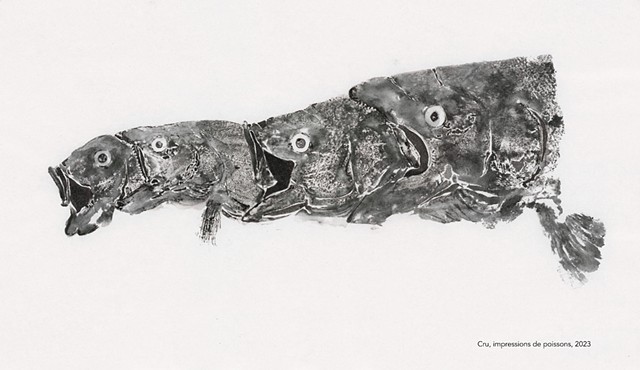
La trace laissé par le dessin, la signature du gyotaku, la cartographie sensible et l’installation deviennent ainsi des outils d’observation et d’inscription. Ils ne cherchent pas seulement à représenter le vivant, mais à donner à voir les relations qui le traversent : les forces, les obstacles, les présences discrètes, les continuités partielles. Entre art, terrain et anthropologie, ma pratique cherche à rendre perceptibles les formes de vie qui persistent dans des milieux transformés.
English
I develop a research-creation practice situated at the intersection of visual arts, environmental anthropology, and anthropology of the living. Trained in visual arts and currently engaged in doctoral research in anthropology, I approach creation as a way of investigating human-animal relations, aquatic environments, infrastructures, and the forms of passage that move through them.
My work focuses on sometimes frontal encounters between living beings and human-made infrastructures: a dam in a river, a migratory passage, an interrupted current line, a body displaced by a technical device. Working from environments connected to the St. Lawrence River, its tributaries, and certain riverine territories, I observe how the trajectories of living beings are transformed, fragmented, or diverted.
Lines occupy a central place in this practice, but they are not only signs to be interpreted. They also exist for themselves. In my drawings, they accumulate, cross, and thicken into dense circulations, sometimes indifferent to what one might want them to signify. They accompany currents, migrations, traces, thresholds, and interrupted passages, allowing what moves, resists, or escapes to appear.
Drawing, gyotaku, sensitive cartography, and installation thus become tools of observation and inscription. They do not simply seek to represent the living, but to make visible the relations that move through it: forces, obstacles, discreet presences, partial continuities. Between art, fieldwork, and anthropology, my practice seeks to render perceptible the forms of life that persist in transformed environments.